
Journal · May 26, 2026
Social-Emotional Learning for Kids: Helping Children Grow with Confidence, Kindness, and Resilience
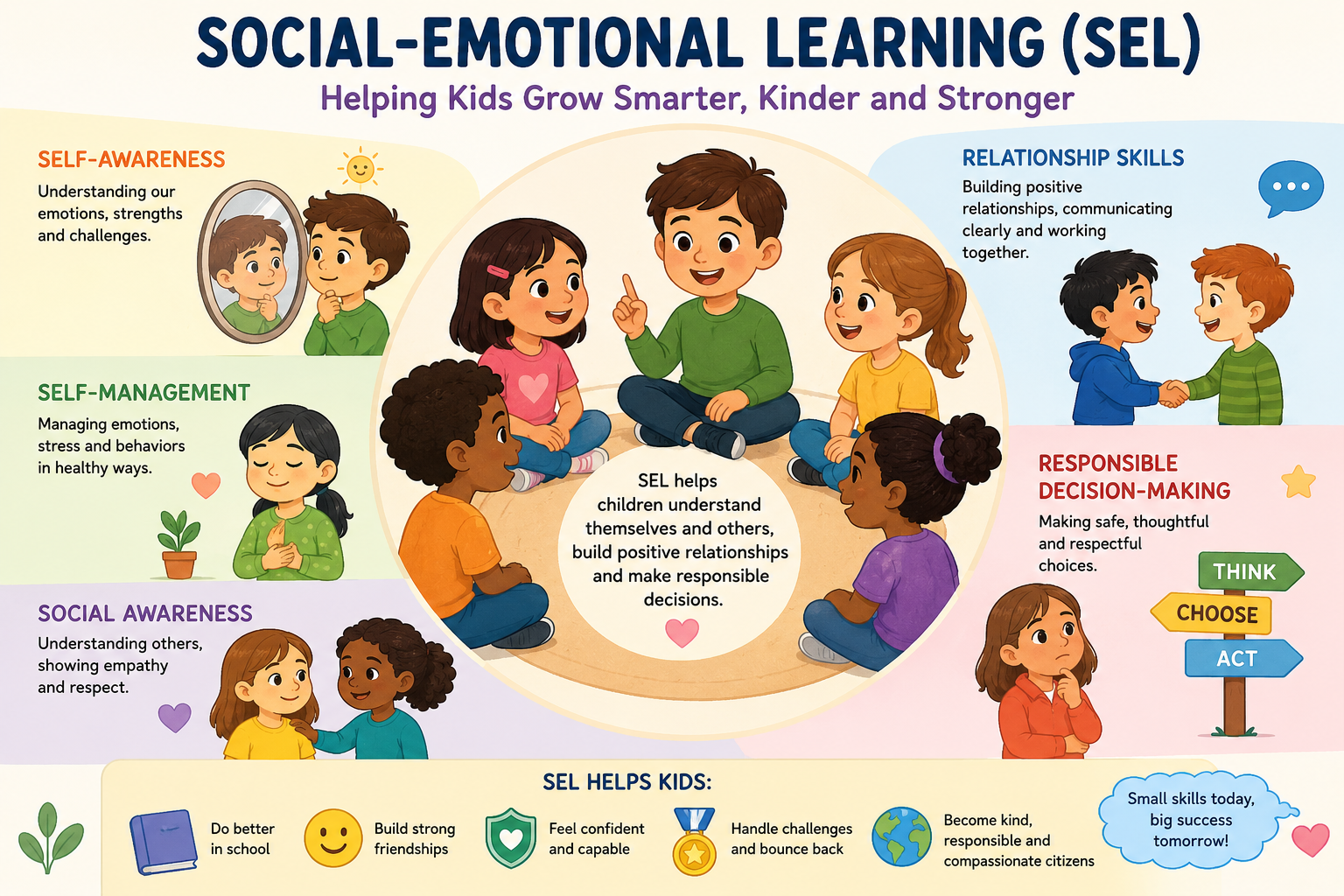
When we think about preparing children for the future, we often focus on reading, writing, math, and science. While these academic skills are essential, another set of abilities is just as important for lifelong success—social-emotional learning, often called SEL.
Social-emotional learning includes skills like understanding emotions, managing feelings, showing empathy, building healthy relationships, and making thoughtful decisions. These abilities help children navigate school, friendships, challenges, and everyday life with confidence and kindness.
The good news is that SEL isn't taught through special classes alone. Parents and caregivers can nurture these skills through everyday conversations, play, stories, and routines.
Let's explore how social-emotional learning supports children's growth and how you can encourage it at home.
What Is Social-Emotional Learning?
Social-emotional learning is the process through which children develop the skills needed to understand themselves, relate to others, and make positive choices.
According to educators and child development experts, SEL includes five core areas:
- Self-awareness — recognizing emotions, strengths, and personal values
- Self-management — managing stress, controlling impulses, and working toward goals
- Social awareness — understanding and empathizing with others
- Relationship skills — communicating clearly, listening, cooperating, and resolving conflicts
- Responsible decision-making — considering consequences and making caring choices
These skills work together to help children feel secure, build friendships, and face challenges in healthy ways.
Why Social-Emotional Learning Matters
Research consistently shows that children with strong social-emotional skills tend to do better in school, have healthier friendships, and experience less stress and anxiety.
Children who develop SEL skills are often better able to:
- Express their feelings with words instead of outbursts
- Handle disappointment and frustration
- Understand how others feel
- Work cooperatively in groups
- Solve problems peacefully
- Build confidence in new situations
- Maintain positive relationships with peers and adults
In fact, many experts believe that emotional intelligence is just as important as academic intelligence when it comes to long-term success and happiness.
Talk About Emotions Openly
One of the simplest ways to support SEL is to talk about feelings regularly.
Children need vocabulary to describe what they are experiencing. Instead of only saying "Don't be sad" or "Stop crying," help them name their emotions.
You might say:
- "It looks like you're feeling frustrated because the blocks fell over."
- "I can see you're excited about your friend's birthday party."
- "It's okay to feel nervous on the first day of school."
When children learn to name their emotions, they gain the first step toward managing them.
Model Healthy Emotional Regulation
Children learn how to handle emotions by watching the adults around them.
When parents stay calm during stressful moments, take deep breaths, or apologize after losing their temper, they teach children that emotions can be managed.
Simple strategies like counting to ten, taking a walk, or using quiet words can become powerful habits when children see them practiced consistently.
Teach Empathy Through Everyday Moments
Empathy is the ability to understand and share the feelings of another person. It is one of the most important social-emotional skills.
You can build empathy through everyday conversations:
- "How do you think your friend felt when you shared your toy?"
- "That child looks sad. What could we do to help?"
- "How would you feel if someone took your turn?"
Reading stories is another wonderful way to develop empathy. When children follow characters through different experiences, they learn to see the world from another person's perspective.
Encourage Problem-Solving and Conflict Resolution
Disagreements between children are normal. Rather than stepping in immediately, parents can guide children toward solving problems themselves.
Helpful steps include:
- Calming down first
- Listening to each person's side
- Identifying the problem
- Brainstorming fair solutions
- Choosing one idea to try
Over time, children learn that conflicts can be solved peacefully and that their voice matters.
Build Confidence Through Responsibility
Giving children age-appropriate responsibilities helps them feel capable and valued.
Small tasks such as:
- Setting the table
- Feeding a pet
- Sorting laundry
- Cleaning up toys
- Helping a younger sibling
These responsibilities build self-esteem and teach children that they can contribute positively to their family and community.
Practice Gratitude and Kindness
Gratitude and kindness are habits that strengthen social-emotional health.
Simple family practices include:
- Sharing one good thing from the day at dinner
- Writing thank-you notes together
- Doing small acts of kindness for neighbors
- Complimenting each other genuinely
When children focus on gratitude, they develop a more positive outlook and stronger connections with others.
Use Play and Stories to Teach SEL
Play is one of the most natural ways children learn social-emotional skills.
Pretend play, board games, and group activities give children opportunities to practice sharing, taking turns, cooperating, and managing emotions.
Stories also offer powerful lessons. Books about friendship, courage, honesty, and kindness help children understand complex emotions and social situations in a safe and engaging way.
Create a Safe and Supportive Environment
Children develop social-emotional skills best when they feel safe, loved, and accepted.
A supportive home environment includes consistent routines, clear expectations, warm interactions, and open communication. When children know they can share their feelings without judgment, they are more likely to develop emotional honesty and resilience.
Final Thoughts
Social-emotional learning is one of the greatest gifts we can give our children. It helps them grow into confident, kind, and resilient individuals who can build healthy relationships and face life's challenges with strength.
By talking about emotions, modeling empathy, encouraging responsibility, and creating a supportive home, parents help children develop skills that will benefit them for a lifetime. Every small conversation and caring moment is a step toward raising emotionally healthy and compassionate children.